This article has been reviewed for clinical accuracy by Dr. Rachel Armstrong
Why is it so hard to stop habits that stress you out?
Many of us pride ourselves on being responsible, working hard, planning ahead, staying calm, and avoiding conflict. Our culture celebrates these traits because they help us succeed and keep the peace.
But what happens when those exact habits cost you your peace of mind? When staying quiet, double-checking every detail, or hiding how you feel leaves you exhausted and disconnected?
Sometimes, the habits that once helped us through hard times become so automatic that we keep using them, even when they no longer fit the situation.

If a habit is causing problems in your life, you might ask yourself: Why am I still doing it?
The answer comes down to how our brains learn. Habits usually start because they solved a real problem in the past. And the truth is, sometimes those habits still work today. That is exactly why they are so hard to change.
As Dr. Kalee Gross says, “Sometimes pretending that you’re okay in a situation can prevent a conflict. Sometimes working those long hours can result in getting that job promotion… Maybe planning ahead does prevent a future problem.”
We stick with these patterns because they bring real rewards. Because these actions worked before, your brain learns that using intense self-control is the best way to stay safe and successful.
You might think that for a habit to stick, it has to work every single time. But brain science shows us the exact opposite.
Dr. Gross explains that “occasional rewards actually make habits even harder to break. And perhaps somewhat counterintuitively, that intermittent reinforcement or occasional reward makes it harder for us to break. So if we think about those slot machines in Vegas, they don’t always pay us. It’d be great if they did, but it only occasionally reinforces us. And despite this, we keep feeding money into it.
Why do we do that?
Well, that’s because our brain knows that reward is available, just not when it will arrive.
So thus, when playing those slots in Las Vegas, when we’re not immediately rewarded, we keep going.
Unlike a different kind of machine, like a vending machine or soda machine. If we put money into it and we don’t get our snack or our soda coming out, we usually tend to shake the machine or kick it because our brain has learned that immediately we’re supposed to get a reward for this from the soda machine or the vending machine every time.
So that intermittent reinforcement, that occasional reinforcement, is what keeps us so stuck in habits like gambling, or it makes it so addictive for us, or even more difficult for us to break.”
When self-control turns into overcontrol, helpful routines can start to feel like rigid rules. Here are common signs that your coping strategies might be holding you back:
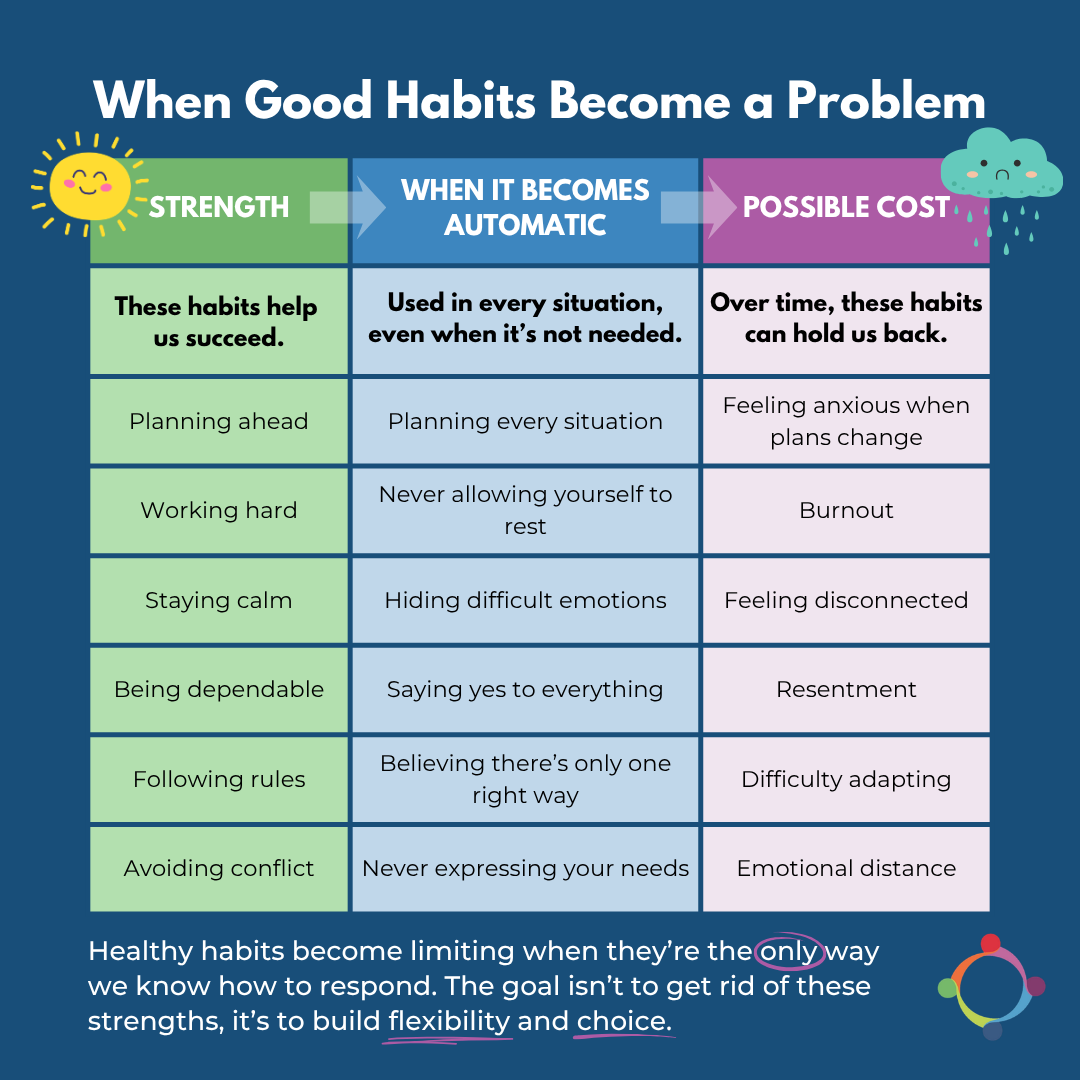
If reading that list feels uncomfortable, you are not alone. Overcontrolled behavior is highly valued in our society.
People love a friend who never complains, an employee who works late, and a person who always follows the rules.
Because these traits are praised, people often worry that changing means they have to become careless, lazy, or reckless.
The goal is not to throw away your hard work or stop planning ahead. The goal is to build flexibility.
A healthy habit becomes unhealthy when it is the only response you have left.
Dr. Gross explain that it’s a “lack of flexible responding because it becomes just almost like a way of doing, a way of being, that we don’t even think about it. And so then we’re responding the same way over and over again regardless of the context. And that can be pretty problematic.”
If you use the exact same quiet, closed-off coping style in every situation, whether you are at work, with your family, or hanging out with close friends, you lose the ability to adapt. Being healthy does not mean giving up self-control. It means knowing when to use control, and knowing when it is safe to let it go.
This balance is at the heart of Radically Open Dialectical Behavior Therapy (RO-DBT).
While many traditional therapies focus on helping people gain more self-control over impulsive behaviors, RO-DBT was developed specifically for people who already have too much control. It is designed for those whose natural strengths (like high responsibility, strict discipline, and hard work) have become so automatic that they cause loneliness and stress.
RO-DBT teaches people how to step back and notice these automatic responses. Instead of acting on autopilot, you learn how to pause, stay open to new information, and choose a response that actually fits the present moment. The habits that helped you get to where you are today do not have to disappear. But if those habits are leaving you feeling exhausted, isolated, or stuck, learning how to adapt your response might be the most rewarding skill you ever build.

Dr. Rachel Armstrong obtained her doctorate from William James College in Boston, MA. She received training and clinical experience in behavioral health interventions and health psychology, including training in clinical hypnosis for IBS, biofeedback assisted relaxation training, and behavioral medicine interventions. She completed her APA-accredited internship at LifeStance Health where she gained experience working in integrated behavioral health settings. Currently, Dr. Armstrong is a postdoctoral fellow at UCEBT.
Therapy isn’t about becoming a different person. It’s about learning when to rely on your strengths and when a different approach may serve you better.
