Length
2 hours
CE Credit
Not available
Recorded
June 26, 2023
This lecture will describe the ethical imperative of self-care for mental health providers. This talk will outline the core principles of ACT, describe how to personally apply ACT to alleviate burnout as mental health professionals, and utilize in vivo practice to familiarize participants with the experiential nature of the therapy.
Further, this talk will discuss the assumptions of Internal Family Systems (IFS) theory, report the view of the therapeutic relationship according to IFS, explain how to use IFS for self-care and guide the examination of participants’ own parts through an experiential exercise to familiarize participants with the model.

There are several ways to learn from this training. You can watch the recording for free and also have the slides available to download.
(Free) You can watch the full recording of this training for free on our YouTube Channel. This is perfect if you’re not seeking CE credit or would like to preview the training before taking the course.
Follow along with the recording by downloading the presentation slides personal use.
However, please note that no part of the materials available through the Utah Center for Evidence Based Treatment may be copied, photocopied, reproduced, translated or reduced to any electronic medium or machine-readable form, in whole or in part, without prior written consent of the presenter and creator of the presentation. Contact info@ucebt.com for questions.
At the conclusion of this presentation, attendees should be able to describe the ethical imperative of self-care for mental health providers, the basic assumptions of the IFS model and describe the qualities of the therapeutic relationship during IFS treatment.
Attendees will experience an IFS mindfulness practice to enhance understanding of the model and promote their own self-care. Attendees should also be able to describe the six core principles of the ACT model and experience an ACT exercise to enhance personal understanding of the model. Participants will also be guided to additional resources for learning and applying IDS and ACT for burnout and compassion fatigue.
Learning Objectives:
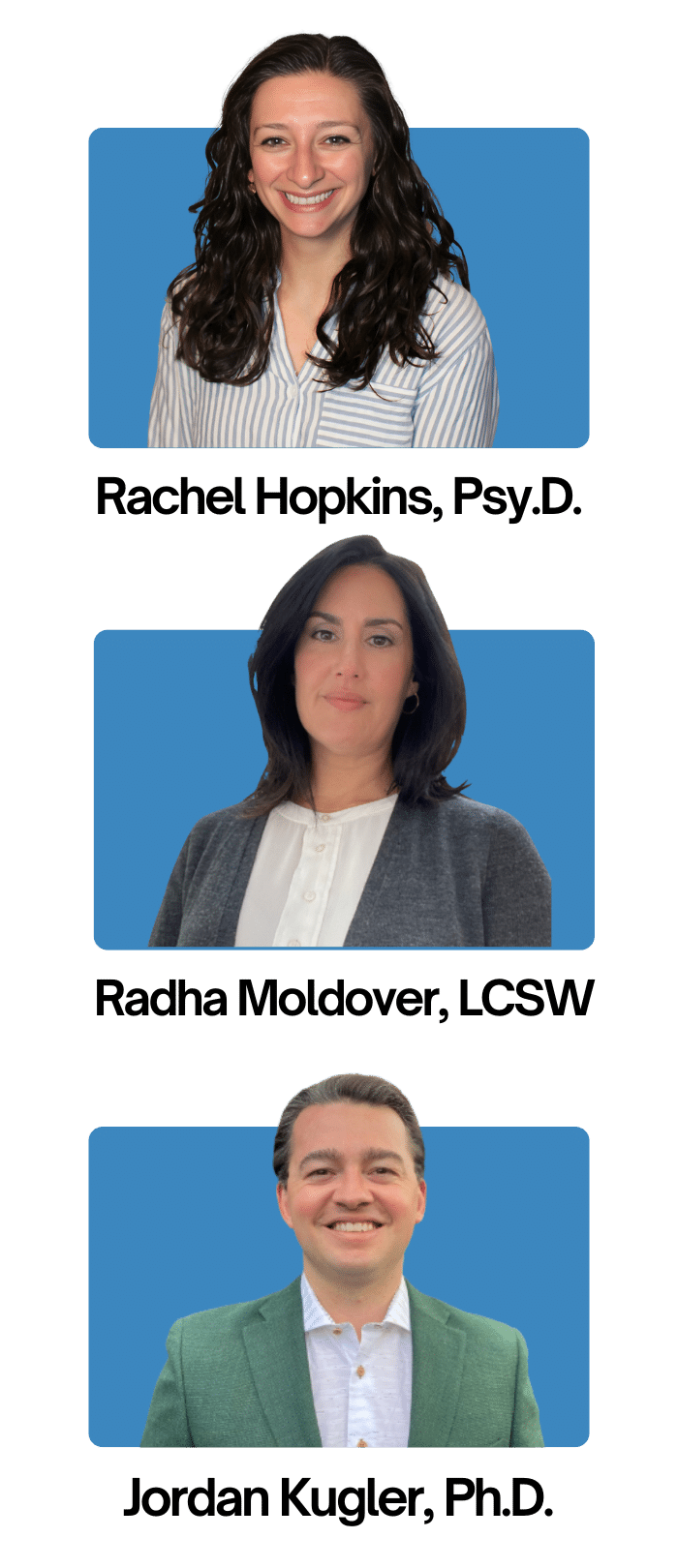
Rachel Hopkins, Psy.D. earned her Doctorate in Clinical Psychology from The Institute of Graduate Clinical Psychology (IGCP) at Widener University in 2018. She is currently the Program Director of the Anxiety and Mood Team at UCEBT where she treats clients presenting with a wide variety of presenting problems and supervises other licensed psychologists and unlicensed trainees. Rachel has been utilizing ACT since the start of her doctoral program, has completed a variety of trainings in ACT, and has presented to mental health professionals and the general public on ACT for children and adolescents, recovery and addiction, and culturally diverse populations.
Radha Moldover, L.C.S.W. Radha earned her Master of Social Work at the State University of New York, Albany and has practiced as a licensed clinical social worker since 2000. Radha has been a student of Internal Family Systems since 2021. She’s completed 25 hours of formal training in the model and has experiential practice in applying IFS to burnout, compassion fatigue and moral injury.
Jordan Kugler, Ph.D., earned his Doctorate of Clinical and Counseling Psychology in 2021 at Utah State University and has practiced as a licensed clinical psychologist since 2021. Jordan has research and clinical experience in post-trauma reactions and trauma-focused interventions. He is intensively trained and has experiential practice in applying Acceptance and Commitment Therapy, Dialectical Behavior Therapy and Mindfulness-based interventions to burnout and building resilience.
Hodgdon, H. B., Anderson, F. G., Southwell, E., Hrubec, W., & Schwartz, R. (2021). Internal Family Systems (IFS) therapy for posttraumatic stress disorder (PTSD) among survivors of multiple childhood trauma: A pilot effectiveness study. Journal of Aggression, Maltreatment & Trauma, 31(1), 22–43. https://doi.org/10.1080/10926771.2021.2013375
Prudenzi, A., Graham, C. D., Flaxman, P. E., Wilding, S., Day, F., & O’Connor, D. B. (2022). A workplace Acceptance and Commitment Therapy (ACT) intervention for improving healthcare staff psychological distress: A randomised controlled trial. PloS one, 17(4), e0266357. https://doi.org/10.1371/journal.pone.0266357
Reeve, A., Tickle, A. and Moghaddam, N. (2018), “Are acceptance and commitment therapy-based interventions effective for reducing burnout in direct-care staff? A systematic review and meta-analysis”, Mental Health Review Journal, Vol. 23 No. 3, pp. 131-155. https://doi.org/10.1108/MHRJ-11-2017-0052
Shadick, N. A., Sowell, N. F., Frits, M. L., Hoffman, S. M., Hartz, S. A., Booth, F. D., Sweezy, M., Rogers, P. R., Dubin, R. L., Atkinson, J. C., Friedman, A. L., Augusto, F., Iannaccone, C. K., Fossel, A. H., Quinn, G., Cui, J., Losina, E., & Schwartz, R. C. (2013). A randomized controlled trial of an internal family systems-based psychotherapeutic intervention on outcomes in rheumatoid arthritis: a proof-of-concept study. The Journal of rheumatology, 40(11), 1831–1841. https://doi.org/10.3899/jrheum.121465
Towey-Swift, K. D., Lauvrud, C., & Whittington, R. (2023). Acceptance and commitment therapy (ACT) for professional staff burnout: a systematic review and narrative synthesis of controlled trials. Journal of mental health (Abingdon, England), 32(2), 452–464. https://doi.org/10.1080/09638237.2021.2022628
We have provided expert virtual trainings and self-paced courses for
continuing education credit since 2020 on a variety of evidence-based topics.
The unique mission of UCEBT is to improve the quality of mental health care by enhancing access to comprehensive evidence-based treatments, evaluations, and testing.
Quick Links
Visit Us
Business Address:
170 S 1000 E, Suite 201
Salt Lake City, UT
84102
Business Hours:
Monday
Tuesday
Wednesday
Thursday
Friday
Saturday – Sunday
9:00 am – 7:00 pm
9:00 am – 7:00 pm
9:00 am – 7:00 pm
9:00 am – 6:00 pm
9:00 am – 5:00 pm
Closed
© 2024 Utah Center for Evidenced Based Treatment. Powered by Big Red Jelly.
