
This article has been reviewed for clinical accuracy by Dr. John Barr
Arguments are a normal part of relationships. The goal isn’t to avoid conflict, but to handle it in ways that help both partners feel heard and understood. Disagreements can even reveal unmet needs and help couples understand each other better.
The challenge is that communication gets harder when emotions rise. You may stop listening, become defensive, focus on what your partner is doing wrong, or shut down. Recognizing these patterns can help you approach conflict more constructively.

Gottman researchers identify criticism, defensiveness, contempt, and stonewalling as four communication patterns that can be particularly damaging during conflict.
Criticism turns a complaint into an attack on your partner’s character. Defensiveness can involve counterattacking or focusing entirely on why you aren’t responsible. Contempt communicates disrespect or superiority. Stonewalling occurs when someone withdraws from the interaction and stops engaging.
These patterns can quickly feed one another. Feeling criticized can make someone defensive. Feeling ignored can make the other partner push harder. That increased pressure may cause the first partner to withdraw even further.
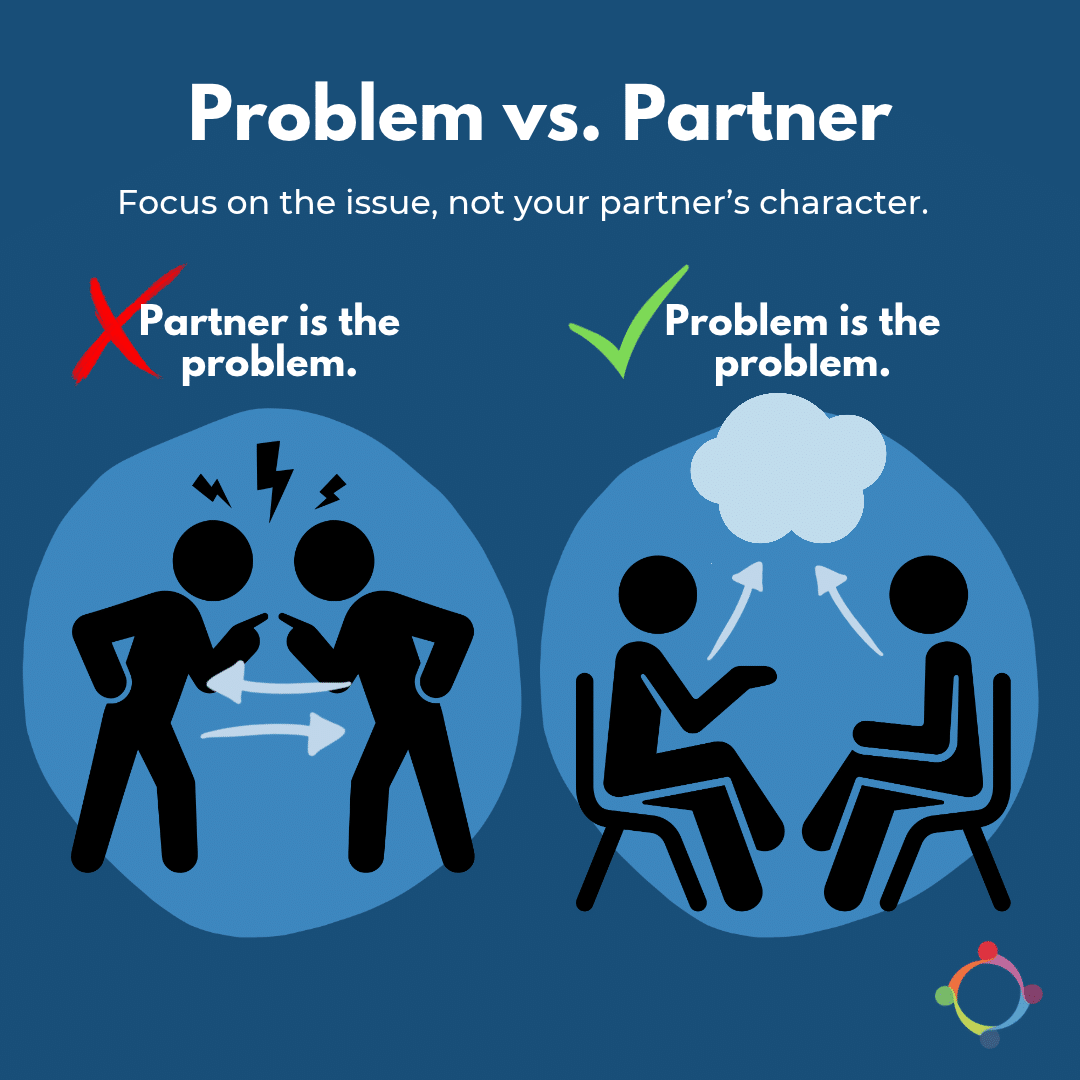
A more productive starting point is to separate your partner from the problem.
For example, imagine that you spent the afternoon cleaning and your partner comes home without acknowledging it. You could say, You didn’t even notice everything I did. What’s wrong with you?
Or you could communicate the same complaint through your own experience: I put a lot of work into cleaning today. When it wasn’t acknowledged, I felt underappreciated. I’d like some recognition for the work I did.
The second version doesn’t avoid the problem. It makes the problem easier to respond to because it tells your partner what happened, how you feel, and what you need without making their character the subject of the argument.
It is often easier to identify what you don’t want from your partner: Stop ignoring me. Don’t look at your phone. Don’t dismiss what I’m saying.
But underneath many complaints is a need or longing. Identifying it gives your partner useful information about what would help.
For example, Stop looking at your phone when I’m talking identifies an unwanted behavior. When I’m talking about something important, I need your full attention identifies the need underneath it.
Gottman-based guidance refers to this as expressing a positive need: asking for what you would like to happen instead of focusing only on what you want your partner to stop doing.
Listening during an argument is difficult because while your partner is talking, you may already be thinking, That’s not what happened, You’re leaving something out, or But you did the same thing last week.
Instead of immediately responding to those thoughts, try temporarily postponing your own argument and focusing on understanding your partner’s experience.
Ask questions that help you understand rather than challenge. What bothered you most about that? What did you need from me in that moment? Then reflect back what you heard and give your partner an opportunity to correct anything you misunderstood.
This doesn’t mean you have to agree.
You might say, I can understand why that felt dismissive to you, without agreeing that you intended to be dismissive. Understanding your partner’s experience and agreeing with their interpretation are two different things.
The same applies to taking responsibility. You don’t have to decide that your partner is completely right in order to acknowledge your part. Perhaps you were distracted, your tone was harsher than you intended, or you didn’t realize how your behavior would affect them. Even a small, genuine acknowledgment can interrupt defensiveness and make it easier to move forward.
Only after both partners understand what the other person is trying to communicate does it make sense to start looking for solutions or compromise. What can each person be flexible about? What matters most? Is there a way to address the underlying needs of both people?
Sometimes better communication means temporarily stopping the conversation.
One reason is emotional flooding, which occurs when someone becomes physiologically overwhelmed during conflict. A person may experience an increased heart rate, shallow breathing, sweating, muscle tension, or other signs of a stress response. From the outside, however, they may simply appear quiet, distant, or shut down.
When someone is flooded, listening and problem-solving become much more difficult. Continuing to push for a resolution can make the interaction worse.
If you’re becoming overwhelmed, try communicating that directly: I’m getting too worked up to have this conversation well. I need a break, but I want to come back to it.
Gottman guidance recommends taking at least 20 minutes to allow physiological arousal to decrease, then returning to the conversation once you feel ready.
During that time, try not to continue the argument in your head. Replaying what your partner said or preparing your next rebuttal can keep you activated. Instead, do something calming or distracting that allows your body to settle.
Taking a break this way is different from stonewalling. The purpose isn’t to abandon the conversation. It’s to return when both people are better able to participate in it.
The way couples communicate during disagreements is influenced by what happens outside of them, too. The Gottman framework emphasizes creating a broader relationship climate of warmth, affection, attention, empathy, and appreciation.
One way to strengthen that foundation is to practice listening when there isn’t a conflict to resolve.
When your partner tells you about a stressful day, for example, notice whether your first impulse is to give advice or fix the problem. Problem-solving may come from a caring place, but sometimes what your partner needs first is to feel understood.
Listen without an agenda. Ask about what was difficult. Reflect what you hear. Try to understand what your partner is feeling before offering solutions.
Over time, these everyday interactions can help create a relationship in which both partners are accustomed to being curious about each other’s experiences not only when something has gone wrong.
Knowing what healthier communication looks like doesn’t necessarily make long-standing patterns easy to change. If you repeatedly have the same arguments, struggle to communicate without criticism or defensiveness, regularly become overwhelmed or shut down, or have difficulty repairing after conflict, couples therapy can provide a structured setting for identifying those patterns and practicing different ways of responding.
These strategies are also not appropriate for every relationship problem. Basic communication techniques should not be treated as a substitute for appropriate professional support in situations involving domestic violence, active substance abuse, or serious infidelity.
The Utah Center for Evidence Based Treatment offers evidence-based couples therapy, including the Gottman Method for Couples Therapy, to help couples understand patterns that keep them stuck and develop healthier ways to communicate, manage conflict, and reconnect.
Benson, K. (2017). Understanding must precede advice. The Gottman Institute. https://www.gottman.com/blog/understanding-must-precede-advice/
Benson, K. (2026). Transforming criticism into wishes: A recipe for successful conflict. The Gottman Institute. https://www.gottman.com/blog/transforming-criticism-into-wishes-a-recipe-for-successful-conflict/
Rusnak, K. (2026). Does flooding play a role in your perpetual conflict? The Gottman Institute. https://www.gottman.com/blog/does-flooding-play-a-role-in-your-perpetual-conflict/
The Gottman Institute. (2026). The Four Horsemen: Criticism, contempt, defensiveness, and stonewalling. https://www.gottman.com/blog/the-four-horsemen-recognizing-criticism-contempt-defensiveness-and-stonewalling/

Dr. John Barr uses Gottman methods and emotion-focused techniques when working with couples. He has expertise treating trauma, anxiety disorders, OCD, depression, somatic symptom and chronic pain struggles, especially as they overlap with trauma. This work is rooted deeply in evidence-based practice, where he incorporates Acceptance and Commitment Therapy (ACT), CBT-based psychotherapies, and formal and informal exposure-focused techniques.
Couples therapy can help you build healthier communication patterns, navigate conflict, and feel more connected.
