This article has been reviewed for clinical accuracy by Dr. Rachel Armstrong
Have you ever looked around a room full of people and still felt completely alone?
Maybe you have friends. Maybe you’re married. Maybe people describe you as dependable, successful, or easy to get along with. Yet somehow, something still feels missing.
The answer isn’t always that you need more relationships. Sometimes it’s that the people around you don’t know the real you.

When looking at how people experience relationships, there is a clear difference between physical loneliness and emotional loneliness.
Some individuals experience physical loneliness, meaning they have very few people in their lives or limited social interaction. However, many people have many relationships friends, family, coworkers, or partners and still feel deeply, profoundly alone.
Being Alone | Emotional Loneliness |
|---|---|
Few relationships | Plenty of relationships |
Limited social interaction | Feeling unseen and/or misunderstood |
Solitary environment | Feeling like nobody truly knows you |
To understand emotional loneliness, we have to look at how people handle vulnerability. Many individuals develop what experts call an overcontrolled coping style.
People with this style tend to:
Individuals with overcontrolled coping styles engage their emotions by engaging excessive self-control. They might present a stoic or distant front to keep themselves from looking out of control.
Crucial reminder: These can be framed as protective strategies, not flaws. They are armor built to keep you safe from perceived threat.
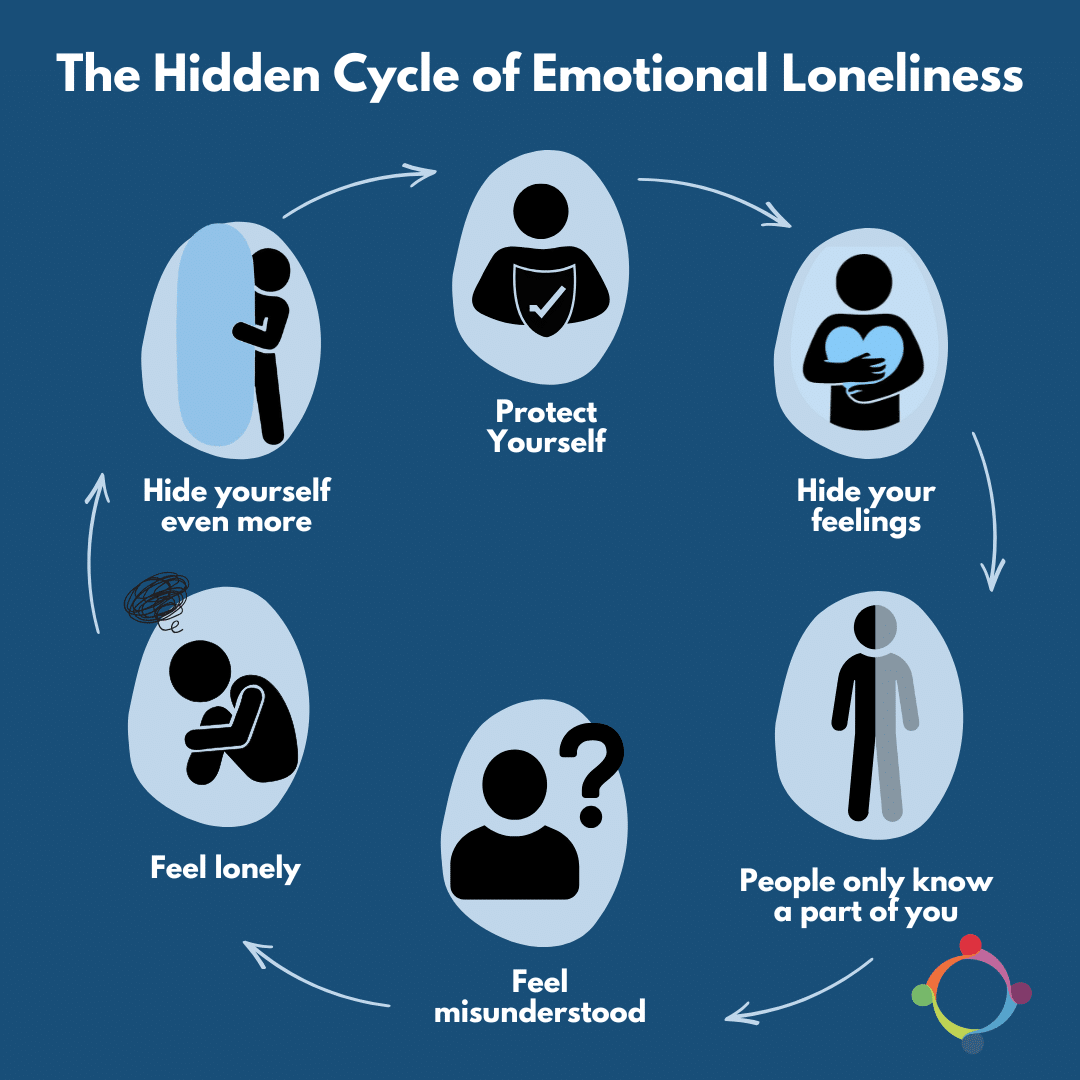
When your nervous system is wired to look out for threats, putting up a wall feels like the only safe option. But that protective armor quietly traps you in a painful loop where closeness becomes impossible:
It starts with an instinct to shield yourself from judgment, conflict, or vulnerability.
To stay safe, you learn to keep your true thoughts, struggles, and emotions locked away.
Because you only show a carefully managed side of yourself, others only get to see the polished, dependable version.
Naturally, this creates a profound disconnect because people are reacting to a mask rather than a real person.
That disconnect and lack of true visibility deepens into the ache of feeling isolated, even in a crowded room or a committed relationship.
Instead of lowering your guard, the pain of that loneliness triggers a fear of exposure, causing you to pull back and close off even further.
Breaking this cycle doesn’t mean finding more people to surround yourself with; it means finding the courage to let the armor down just enough for someone to see the real you.
These patterns do not appear out of nowhere. They often develop for deeply understandable reasons, shaped by a mix of biology and environment:
Biological temperament: Just like eye colors are different, brains are different. Individuals who are overcontrolled tend to have consistent biological differences. Their nervous systems tend to be less sensitive to rewards in their environment and much more sensitive to threat.
Environments that reinforce control: Growing up in a social environment that reinforces control, such as a strict family, a high-pressure sports team, a school, or a culture like Silicon Valley that pushes high performance and structure. Interestingly, these patterns can develop in chaotic environments, where a child experiences so much unpredictability and stress that control becomes the only way to feel safe.
Coping strategies: Using control and emotional restraint to avoid vulnerability, conflict, mistakes, or looking out of control.
The focus shouldn’t be on finding fault with yourself, but on recognizing that these behaviors once served a vital protective purpose.
There is a common misconception that achievement shields us from emotional pain. In reality, therapy offices are full of people who appear:
Yet, they still experience profound emotional loneliness because connection requires being known, not just being admired.
Having an overcontrolled style can help people achieve great things or reaching big professional milestones. But earning praise for what you do does not feed the hunger for someone to understand who you are.
Connection grows when people can:
These exact areas often prove to be the biggest challenges for individuals with overcontrolled coping styles, who tend to inhibit their expressions, avoid risks, and keep their cards close to their chest.
Not everyone who feels lonely needs more people in their lives. Some simply need more opportunities to be known. Sometimes the deepest loneliness isn’t having no one around. It’s believing that if anyone truly knew you, they wouldn’t accept you.
One of the goals of Radically Open Dialectical Behavior Therapy (RO-DBT) is helping people move toward greater openness, flexibility, and genuine connection, not by changing who they are, but by helping them feel safe enough in their nervous systems to let others know them more fully.

Dr. Rachel Armstrong obtained her doctorate from William James College in Boston, MA. She received training and clinical experience in behavioral health interventions and health psychology, including training in clinical hypnosis for IBS, biofeedback assisted relaxation training, and behavioral medicine interventions. She completed her APA-accredited internship at LifeStance Health where she gained experience working in integrated behavioral health settings. Currently, Dr. Armstrong is a postdoctoral fellow at UCEBT.
Lasting change doesn’t come from becoming someone else, it comes from learning new ways to connect with yourself and the people who matter most.
