Length
6 hours
CE Credit
6.0 units
Recorded
July-Aug, 2025
As artificial intelligence rapidly advances, mental health providers are increasingly encountering new technologies that impact clinical work. From session documentation to client-facing tools, AI is reshaping how we assess, plan, and deliver care. But with innovation comes responsibility—and important ethical questions.
In this 3-part CE series, licensed psychologists from the Utah Center for Evidence Based Treatment (UCEBT) explore the evolving intersection of AI and clinical ethics. Participants will gain insight into the latest ethical guidelines, practical applications of AI in therapy, and the nuanced roles therapists may play in the development and regulation of AI in mental health.
Whether you’re curious, cautious, or already using AI, this series offers essential knowledge to make informed, ethically sound decisions in your practice.
Topics include:

There are several ways to learn from this training series. You can either watch the recordings for free or take the self-paced courses for CE credit. We also have the slides available to download.
Learn more about each of the three sessions in this series, below.
(Free) You can watch the full recording of this training for free on our YouTube Channel. This is perfect if you’re not seeking CE credit or would like to preview the training before taking the course.
You can receive 6 hours of self-paced, asynchronous Ethics CE credit for this full training or 2 CE hours per training.
UCEBT is approved by the American Psychological Association to sponsor continuing education for psychologists. UCEBT maintains responsibility for this program and its content.
Additionally, these sessions is approved for home-study Ethics CE credit through UPA, NASW-UT, UAMFT, and UMHCA.
Each self-paced CE course is $57.
Or you can take all three courses for only $135 (a 20% discount):
Follow along with the recording by downloading the presentation slides personal use.
However, please note that no part of the materials available through the Utah Center for Evidence Based Treatment may be copied, photocopied, reproduced, translated or reduced to any electronic medium or machine-readable form, in whole or in part, without prior written consent of the presenter and creator of the presentation. Contact info@ucebt.com for questions.
Part 1: An Introduction to the Ethics of Artificial Intelligence in Clinical Practice
Originally presented Friday, July 18, 2025
Presenter: Dr. Laura Rowley
Please note: UCEBT is approved by the American Psychological Association to sponsor continuing education for psychologists. UCEBT maintains responsibility for this program and its content. These sessions are also approved for ethics CEs through UPA, NASW-UT, UAMFT, and UMHCA.
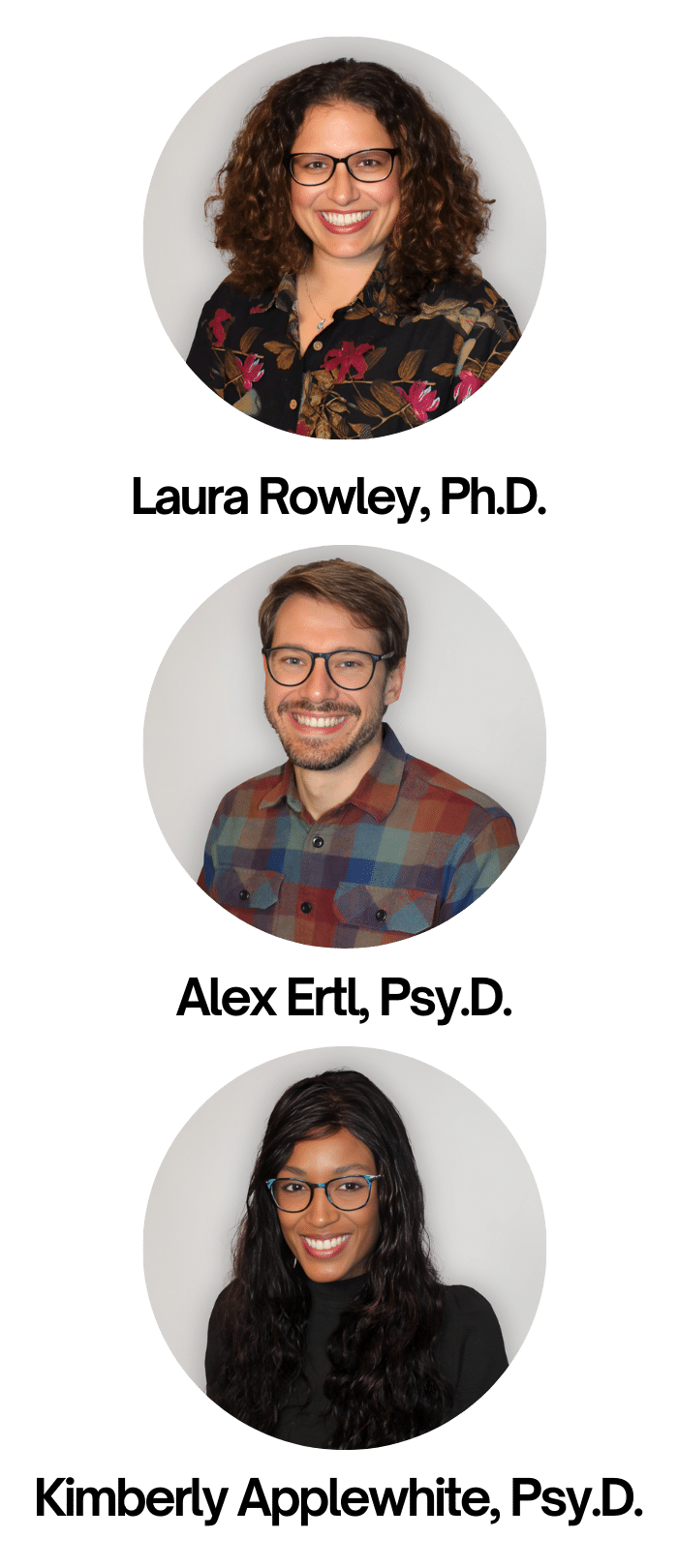
Laura Rowley, Ph.D., licensed clinical psychologist. Laura obtained her doctorate from Wayne State University. She completed her APA-accredited internship and postdoctoral fellowship at Primary Children’s Hospital. Laura was the Program Director for the Assessment and Testing Team at Utah Center for Evidence Based Treatment. Laura has provided ethics trainings on topics relevant to clinical practice, including trends with emerging research.
Alex Ertl, Psy.D. is a licensed psychologist in both Colorado and Utah. Alex has an interest in the intersection of AI, ethics, and clinical practice and has been monitoring the status of AI opportunities within clinical practice.
Kimberly Applewhite, Psy.D. (School-Clinical Child Psychologist) is a licensed clinical psychologist and consultant. She is on the clinical advisory board of an AI-powered mental health support app. Dr. Applewhite is also the program director of the Dialectical Behavior Therapy program at UCEBT, and specializes in DBT for children, adolescents, and adults. She has led skills groups in various settings (outpatient, mental health in primary care, inpatient, day treatment, and residential).
American Psychological Association. (2002). Ethical Principles of Psychologists and Code of Conduct. American Psychologist, 57(12), 1060–1073. https://doi.org/10.1037//0003-066x.57.12.1060
American Psychological Association. (2025). Draft Review of Proposed APA Ethical Code. Apa.org. https://www.apa.org/ethics/making-your-voice-heard
D’Alfonso, S. (2020).
AI in Mental Health. Current Opinion in Psychology, 36, 112–117. https://doi.org/10.1016/j.copsyc.2020.04.005
Carr, S (2020). AI gone mental: engagement and ethics in data-driven technology for mental health. Journal of Mental Health, 29, 125-130. https://doi.org/10.1080/09638237.2020.1714011
de Mello, F. L., & de Souza, S. A. (2019). Psychotherapy and Artificial Intelligence: A Proposal for Alignment. Frontiers in Psychology, 10. https://doi.org/10.3389/fpsyg.2019.00263
Ellen E. Lee, John Torous, Munmun De Choudhury, Colin A. Depp, Sarah A. Graham, Ho-Cheol Kim, Martin P. Paulus, John H. Krystal, Dilip V. Jeste, Artificial Intelligence for Mental Health Care: Clinical Applications, Barriers, Facilitators, and Artificial Wisdom, Biological Psychiatry: Cognitive Neuroscience and Neuroimaging, Volume 6, Issue 9, 2021, Pages 856-864, ISSN 2451-9022, https://doi.org/10.1016/j.bpsc.2021.02.001
Fiske, A., Henningsen, P., & Buyx, A. (2019). Your Robot Therapist Will See You Now: Ethical Implications of Embodied Artificial Intelligence in Psychiatry, Psychology, and Psychotherapy. Journal of Medical Internet Research, 21(5). https://doi.org/10.2196/13216
Graham, S., Depp, C., Lee, E. E., Nebeker, C., Tu, X., Kim, H. C., & Jeste, D. V. (2019). Artificial Intelligence for Mental Health and Mental Illnesses: an Overview. Current psychiatry reports, 21(11), 116. https://doi.org/10.1007/s11920-019-1094-0
Hatch SG, Goodman ZT, Vowels L, Hatch HD, Brown AL, Guttman S, et al. (2025) When ELIZA meets therapists: A Turing test for the heart and mind. PLOS Ment Health 2(2): e0000145. https://doi.org/10.1371/journal.pmen.0000145
Olawade, D.B., Wada, O.Z, Odetayo, A., David-Olawade, A.C, Asaolu, F., & Eberhardt, J. (2024). Enhancing mental health with artificial intelligence: current trends and future prospects. Journal of Medicine, Surgery, and Public Health, 3, 1-10. https://doi.org/10.1016/j.glmedi.2024.100099
Vishal Bajotra, & Rani, N. (2024). The Role of Artificial Intelligence in Psychology. Far Western Journal of Education, 1(1), 35–46. https://doi.org/10.3126/fwje.v1i1.68775
We have provided expert virtual trainings and self-paced courses for
continuing education credit since 2020 on a variety of evidence-based topics.
The unique mission of UCEBT is to improve the quality of mental health care by enhancing access to comprehensive evidence-based treatments, evaluations, and testing.
Quick Links
Visit Us
Business Address:
170 S 1000 E, Suite 201
Salt Lake City, UT
84102
Business Hours:
Monday
Tuesday
Wednesday
Thursday
Friday
Saturday – Sunday
9:00 am – 7:00 pm
9:00 am – 7:00 pm
9:00 am – 7:00 pm
9:00 am – 6:00 pm
9:00 am – 5:00 pm
Closed
© 2024 Utah Center for Evidenced Based Treatment. Powered by Big Red Jelly.
