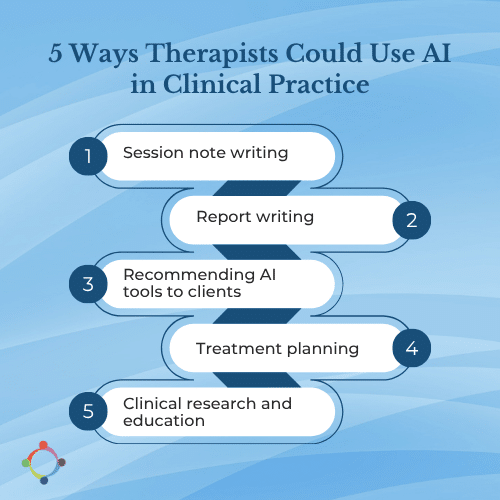
During a Continuing Education training on the use of AI in clinical practice, Dr. Alex Ertl discussed some of the ways that AI is currently being used in therapy as well as some of the things that therapists should consider when using AI in their practice (both AI in therapy and AI in testing).
The full training uses the Tarvydas Integrative Decision-Making Model of Ethical Behavior (Tarvydas & Johnston, 2018) to guide a mental health provider’s decision-making process for these uses of AI in their clinical practice.
“ What’s wonderful about this model is that a combines principle-based ethics and virtue based ethics of decision making while also considering what are contextual factors into the overall process.”
This article reviews the most common uses of AI in psychotherapy and psychological testing as well as some important considerations for providers, supported by commentary from Dr. Ertl taken the training transcripts.
Here are some important ethical and HIPAA-related considerations about how is AI being used in therapy for session note writing:
“Often these programs work by recording audio of the session, creating a transcript, the text of that is then put through an algorithm. So basically, we are inviting a computer program and potentially an unknown quantity of employees who are involved in that computer program or entities that they maybe sell data to, whoever it might be.”
“ We’re going to run into some difficulty of saying, what is a sufficient note? I have maybe dual influences of what I learned in grad school, what a SOAP note is, and then I see my peers doing something that’s less than that standard. Where should I practice?”
“ When we think about those non-moral values, time in my hobbies, time with my family, whatever that might be, we really need to recognize how enticing something like this (AI) might be because our non-moral values are so strong in this.”
Here are some important ethical and HIPAA-related considerations about how is AI being used in therapy for report writing:
“ Especially if someone’s coming to us primarily for assessment rather than psychotherapy, we’re anticipating this client is going to receive this report. They’re probably going to read it over, or at least sections of it, in a very detailed fashion. And we want to consider what is this going to do if clients can tell that AI generated some of this some of this data?
If we’re writing things that are routinely being viewed either in legal systems or in school systems, what does that do for the trust of myself, as in my reputation, or for the profession at large? If people are investing large sums of money and/or time for reports, if I saw an em dash in a psychological report on me, it would certainly make me question how much of this was written by AI. Even if what’s been said is accurate… our clients may still lose trust in us.”
“AI is pretty good at generating summaries if you give it a whole bunch of text… So there could be a strong pull… for when we are considering in our psychological reports, our intake reports, our neuropsych reports, if we’re working on summary sessions, there’s a pull here of ‘Hey, I wonder if AI can do this?’”
“ It could be tempting to plug in… the results of an MPI to create a narrative form based on this. We may be tempted to do that because maybe we’re seeing that work well in other areas.”
“I’ve had clients come in and be like, ‘how likely am I to succeed at college?’ And they want to understand their level of executive functioning in various ways. And AI could probably write something that sounds pretty convincing, but it’s not going to have the clinical judgment of someone who can think in that broader picture and say, here’s likely barriers to succeeding in college. Here are ways to overcome that barrier. There’s just like a lot of context that AI is not going to have available and is not going to have that experience with.”
Here are some important ethical and HIPAA-related considerations about how is AI being used in therapy for recommending AI tools to clients:
Here are some important ethical and HIPAA-related considerations about how is AI being used in therapy for treatment planning:
“If we’re looking for this toward AI for idea generation of like, ‘what treatment should I provide?’ we can anticipate that that starting point is probably going to bias us. So if I ask AI versus a colleague… Maybe someone has presenting comorbid diagnoses and they’re experiencing challenges in two different areas…I might get a different answer from AI versus a colleague. And if I get the answer first from AI, am I going to have some internal bias toward it? Is there going to be more of a primacy effect that takes place here?”
“ If we have this seemingly wonderful tool that can write an entire treatment plan, and it even appears nuance to us, does that then deter us from collaborating with our clients? Do we start to see collaborating with our clients on a treatment plan as something that’s burdensome, as it takes more time?”
“ Maybe I’m hearing about RO-DBT for the first time or maybe I’ve heard of it but I don’t know much about it… should I go to ChatGPT or other resources and say like, ‘tell me about this type of therapy that I’m not as familiar with?’.”
Here are some important ethical and HIPAA-related considerations about how is AI being used in therapy for clinical research and education:
“There’s risk of baseless information and, again, even if fact-checked, our starting points made biased a direction. If we’re going here for idea generation, we recognize that if we’re using this as a starting point, sometimes our starting points bias where our end points are.”