Length
2 hours
CE Credit
Unavailable
Recorded
May 25, 2023
Dissociative Identity Disorder (DID) is a diagnosis that has been mired in controversy even before social media has broadened awareness of it in recent years. Research has encompassed empirical investigation into its etiology, including trauma-dissociation and malingering/suggestion models.
With more adolescents and young adults presenting with traits of DID, it is imperative for clinicians to have the tools for accurate assessment and diagnosis and for supporting our clients in engaging in evidence-based treatment.
This talk will address barriers to accurate DID diagnosis, including limitations in research on BIPOC and minority populations, tools to support DID assessment that address potential malingering, and strategies for communicating case conceptualizations to clients, who may have a strong attachment to a DID diagnosis.
This talk will also provide a brief overview of evidence-based intervention for individuals with DID and individuals with traits of dissociation, but who do not necessarily fit a DID diagnosis.

There are several ways to learn from this training. You can watch the recording for free and we also have the slides available to download.
(Free) You can watch the full recording of this training for free on our YouTube Channel. This is perfect if you’re not seeking CE credit or would like to preview the training before taking the course.
Follow along with the recording by downloading the presentation slides personal use.
However, please note that no part of the materials available through the Utah Center for Evidence Based Treatment may be copied, photocopied, reproduced, translated or reduced to any electronic medium or machine-readable form, in whole or in part, without prior written consent of the presenter and creator of the presentation. Contact info@ucebt.com for questions.
At the conclusion of this presentation, attendees should be able to describe barriers to accurate DID assessment, identify tools in the research for accurate assessment and diagnosis, and identify evidence-based interventions to support individuals with dissociation.
Learning Objectives:
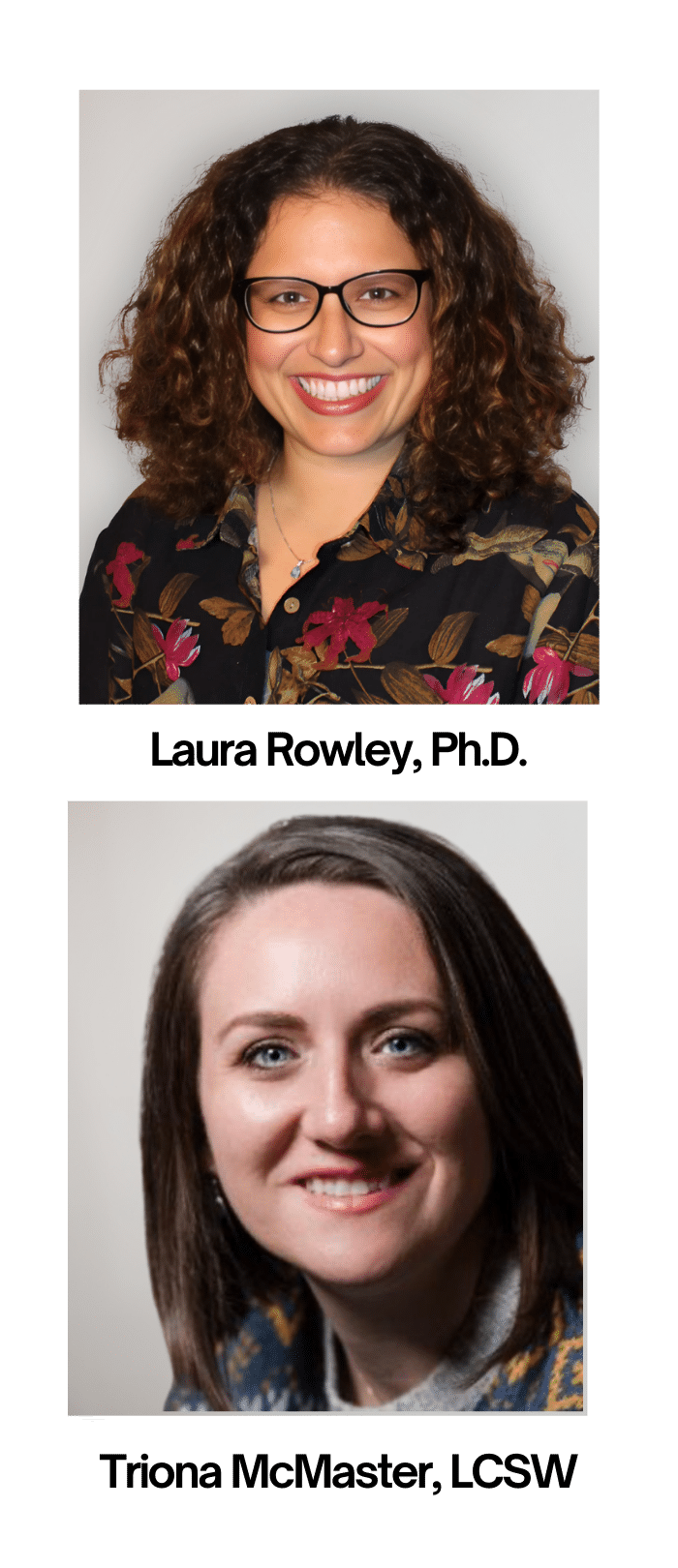
Laura Rowley, Ph.D., licensed clinical psychologist. Laura obtained her doctorate from Wayne State University. She completed her APA-accredited internship and postdoctoral fellowship at Primary Children’s Hospital. Laura was the Program Director for the Assessment and Testing Team at Utah Center for Evidence Based Treatment. Her expertise in assessment includes assessment and differentiating diagnosis of developmental vulnerabilities, complex trauma and dissociation, and personality disorders.
Triona McMaster, LCSW is the Executive Clinical Director at Life Stone Counseling Centers. Triona received her Master’s of Social Work from the University of Utah and has worked in both the inpatient and outpatient settings for over a decade. She is an approved EMDRIA Consultant and Trauma Recovery/HAP Facilitator and provides consultation to other clinicians as they work to improve their knowledge and practice in EMDR. She is passionate about working with those who suffer from anxiety, depression, dissociation, and who have experienced trauma; and has extensive training in these areas.
Brand, B. L., Barth, M., Schlumpf, Y. R., Schielke, H., Chalavi, S., Vissia, E. M., Nijenhuis, E. R. S., Jäncke, L., & Reinders, A. A. T. S. (2021). The utility of the Structured Inventory of Malingered Symptomatology for distinguishing individuals with Dissociative Identity Disorder (DID) from DID simulators and healthy controls. European Journal of Psychotraumatology, 12(1). https://doi.org/10.1080/20008198.2021.1984048
Brand, B. L., Webermann, A. R., Snyder, B. L., & Kaliush, P. R. (2019). Detecting clinical and simulated dissociative identity disorder with the Test of Memory Malingering. Psychological Trauma: Theory, Research, Practice, and Policy, 11(5), 513 520. https://doi.org/10.1037/tra0000405
Krüger, C. (2019). Culture, trauma and dissociation: A broadening perspective for our field. Journal of Trauma & Dissociation, 21(1), 1–13. https://doi.org/10.1080/15299732.2020.1675134
Pietkiewicz, I. J., Bańbura-Nowak, A., Tomalski, R., & Boon, S. (2021). Revisiting False-Positive and Imitated Dissociative Identity Disorder. Frontiers in Psychology, 12. https://doi.org/10.3389/fpsyg.2021.637929
Reinders, A. A. T. S., & Veltman, D. J. (2020). Dissociative identity disorder: out of the shadows at last? The British Journal of Psychiatry, 219(2), 1–2. https://doi.org/10.1192/bjp.2020.168
Wilkinson, S., & DeJong, M. (2020). Dissociative identity disorder: a developmental perspective. BJPsych Advances, 27(2), 1–3. https://doi.org/10.1192/bja.2020.35
We have provided expert virtual trainings and self-paced courses for
continuing education credit since 2020 on a variety of evidence-based topics.
The unique mission of UCEBT is to improve the quality of mental health care by enhancing access to comprehensive evidence-based treatments, evaluations, and testing.
Quick Links
Visit Us
Business Address:
170 S 1000 E, Suite 201
Salt Lake City, UT
84102
Business Hours:
Monday
Tuesday
Wednesday
Thursday
Friday
Saturday – Sunday
9:00 am – 7:00 pm
9:00 am – 7:00 pm
9:00 am – 7:00 pm
9:00 am – 6:00 pm
9:00 am – 5:00 pm
Closed
© 2024 Utah Center for Evidenced Based Treatment. Powered by Big Red Jelly.
